

In the dynamic realm of automotive technology, ADAS (Advanced Driver Assistance Systems) stands as a pioneering force, revolutionizing the driving experience through innovative applications and cutting-edge technologies. In this comprehensive exploration, Garage Equipment Association delve into the intricate workings of ADAS, its diverse applications, and the pivotal role it plays in shaping the future of road safety with (GEA).
How ADAS Works: Navigating the Automotive Technological Landscape
The foundation of the next generation of mobile-connected devices lies in automobiles, evolving rapidly with a focus on autonomous vehicles. ADAS employs a network of applications and technologies partitioned into systems on a chip (SoCs), connecting sensors to actuators through high-performance electronic controller units (ECUs). These advancements aim to provide self-driving cars with a 360-degree vision, utilizing hardware designs that incorporate advanced process nodes to meet performance targets while minimizing power consumption and footprint.
Advanced Driver Assistance Systems Applications: Enhancing Automotive Safety
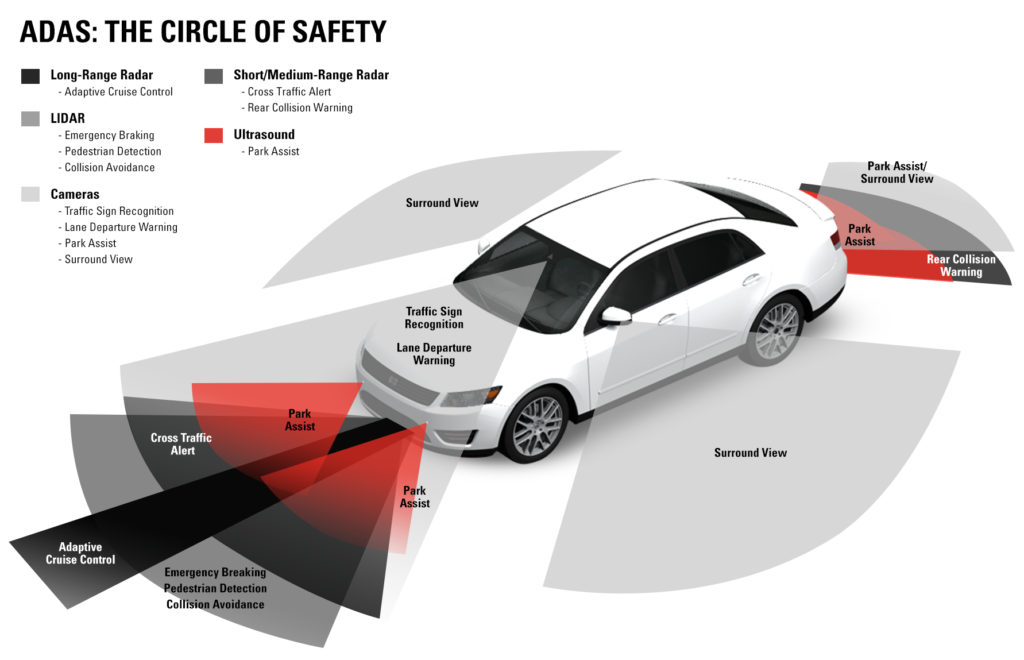
Historically, Automotive Safety improvements were passive measures designed to minimize injury during accidents. ADAS systems, equipped with embedded vision, actively contribute to safety by reducing accidents and minimizing injury. The integration of cameras and AI functions, utilizing sensor fusion with image recognition software, ultrasound sensors, lidar, and radar, enables these systems to respond faster than human drivers.
Common ADAS Applications: Adaptive Cruise Control
Automatically adjusts speed based on surrounding objects.
Glare-Free High Beam and Pixel Light:
Uses sensors to adjust headlights, preventing blinding of oncoming traffic.
Adaptive Light Control: Advanced Driver Assistance Systems
Modifies headlights based on external lighting conditions.
Automatic Parking: ADAS Calibration
Assists drivers in parking, some systems can park automatically.
Autonomous Valet Parking:
Utilizes sensors, 5G communication, and cloud services for autonomous parking.
Navigation System:
Provides on-screen instructions, voice prompts, and real-time traffic updates.
Night Vision:
Enables drivers to see in low-light conditions using infrared or thermal imaging.
Unseen Area Monitoring: Advanced Driver Assistance System Calibration
Uses sensors to detect objects in blind spots and provides alerts.
Automatic Emergency Braking:
Sensors detect potential collisions and engage preventive safety measures.
Driver Monitoring System:
Monitors driver attention using cameras and issues alerts if needed.
5G and V2X:
Enables communication between E-vehicles and pedestrians for enhanced safety.
Why ADAS is Crucial: Reducing Car Accidents and Saving Lives
With a significant percentage of accidents attributed to human error, ADAS emerges as a critical tool to reduce car accidents. Applications like automatic emergency braking, pedestrian detection, and driver drowsiness detection provide safety-critical functionality, contributing to accident prevention and, ultimately, saving lives.
The Future of Advanced Driver Assistance Systems: Navigating Towards Autonomy
As the automotive services evolves, the future of ADAS points towards fully autonomous vehicles capable of sensing their environment and operating without human involvement. This transition necessitates a shift from distributed ADAS electronic controller units (ECUs) to integrated ADAS domain controllers, emphasizing centralized computing architectures.
To support these advancements, there is a growing need for higher computing performance, lower power consumption, and smaller packaging. The adoption of 64-bit processors, neural networks, and AI accelerators becomes imperative to handle the increasing volume of data. The reduction of electronic modules leads to centralized computing architectures, demanding critical automotive building blocks like processors with vision processing capabilities, neural networks, and sensor fusion.
In this era of connected vehicles, subsystem and SoC designers must expand safety measures beyond traditional approaches to ensure physical safety. The incorporation of embedded computer vision and deep learning techniques into automotive SoCs holds the key to achieving greater accuracy, power efficiency, and performance in ADAS systems.
Conclusion:
In conclusion, ADAS Calibration marks a paradigm shift in automotive safety and charts. The course towards a future where vehicles are more than modes of transportation. They become intelligent, interconnected hubs prioritizing safety and efficiency on the road. Contant us for any query related to your car, modification and technology.