

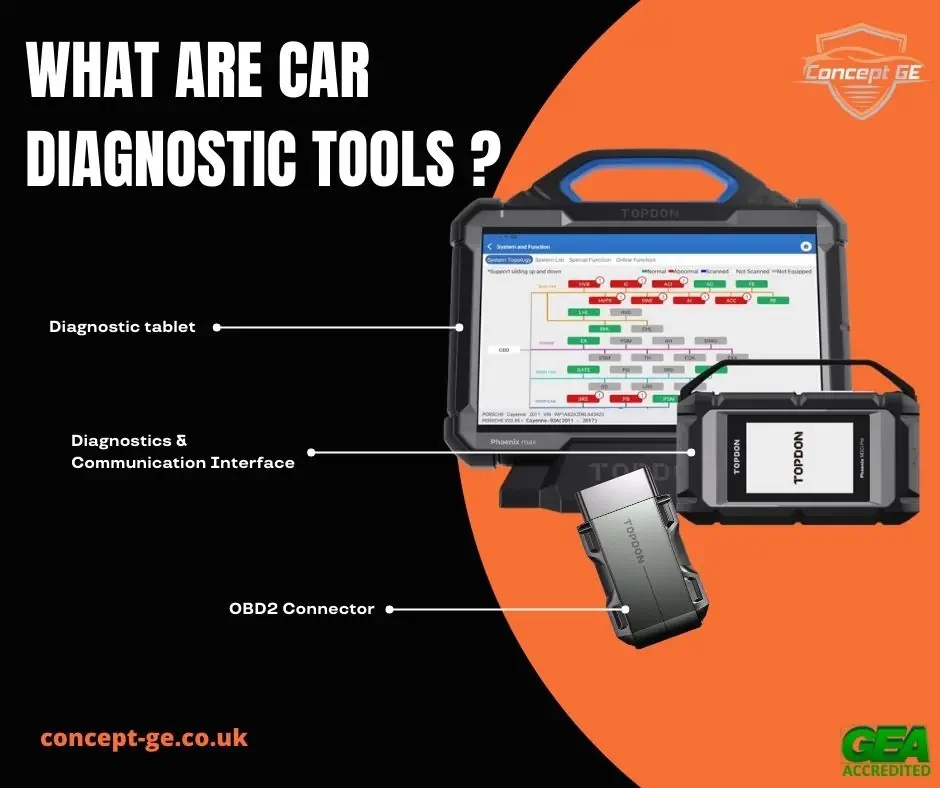
Car diagnostic tools and OBD2 scanners work by scanning a car’s components and systems, like a stethoscope for vehicle electronics, to help look for any issues that might be present with parts like the engine, ignition system, transmission, oil tank, accelerator, and more.
However, since these tests need special devices and expertise to be read accurately, they are usually carried out by mechanics at garages or MOT testing stations.
A vehicle diagnostic tool is a diagnostic scanner that can be plugged into an OBD (OBD I) or OBD2 (OBD II) socket to read and clear codes, as well as view data readouts from various sensors. This can be used to help diagnose problems with a vehicle.
OBD stands for On-Board Diagnostics. This acronym is used to identify a device that can be connected to a car or other vehicle via the OBD port or OBD2 port usually via an OBD cable.
Data collected via a diagnostic scanner can reveal:
An On-Board Diagnostics II (OBD2) port is a universal 16-pin interface that provides access to your vehicle’s internal computer. This port is typically located beneath the driver’s side dashboard and allows technicians and owners to retrieve critical diagnostic trouble codes (DTCs), monitor real-time engine performance, and verify emissions compliance using a digital diagnostic tool.

For some jobs, especially on cars with complex electronics (which is the vast majority on the road these days) a diagnostic scanner is fairly essential now, as well as meaning you can get the job done yourself without having to refer the customer to the main dealer, having one means
Car diagnostic tools usually refer to the OBD or OBD2 tools used for diagnosing engine management, and electrical or mechanical faults with a car, but there are several other tools which fall into this category.
These are the top 5 types of car diagnostic scanners available today:
Yes, but it’s not necessarily the best tool for the job. Using an OBD or OBD2 connector and a mobile phone, some vehicle manufacturers supply software to read OBD codes and diagnose vehicle issues; some can also update or reset them, but this won’t do as much as you can with a diagnostic scanner that was built for the job.
Yes. If you are a garage, workshop, MOT Bay or mobile mechanic, then having a car diagnostic machine is an essential part of your toolbox. With almost all modern cars having elements controlled and monitored by the car’s computer and OBD system, the diagnosis of a problem can be done infinitely faster, or sometimes can only really be determined by the use of a car diagnostic tool.
With older cars prior to 2001, it is somewhat harder due to the OBD standard not being in place and hence it can be more difficult or expensive to ensure you have the correct equipment to read the codes from each vehicle, but for petrol cars built since 2001 and diesel since 2004, the OBD2 standard makes owning a single diagnostic device affordable and essential for any mechanic to have available to do their job quickly and efficiently.
The best tool depends on your needs and budget. Consider:
If you are unsure what you need, or just need some advice, give our sales team a call on 0113 469 0572.
We can address any questions you have and recommend the best diagnostic tools to meet your needs.