

The first stage is a detailed workshop assessment. During the site visit, measurements are taken to determine whether the premises are suitable, which equipment will fit correctly, the groundwork requirements and access considerations. This stage is extremely important because errors in workshop planning can create costly delays later in the process.
When choosing your MOT equipment, you will consider factors including budget, workshop layout and future expansion plans.
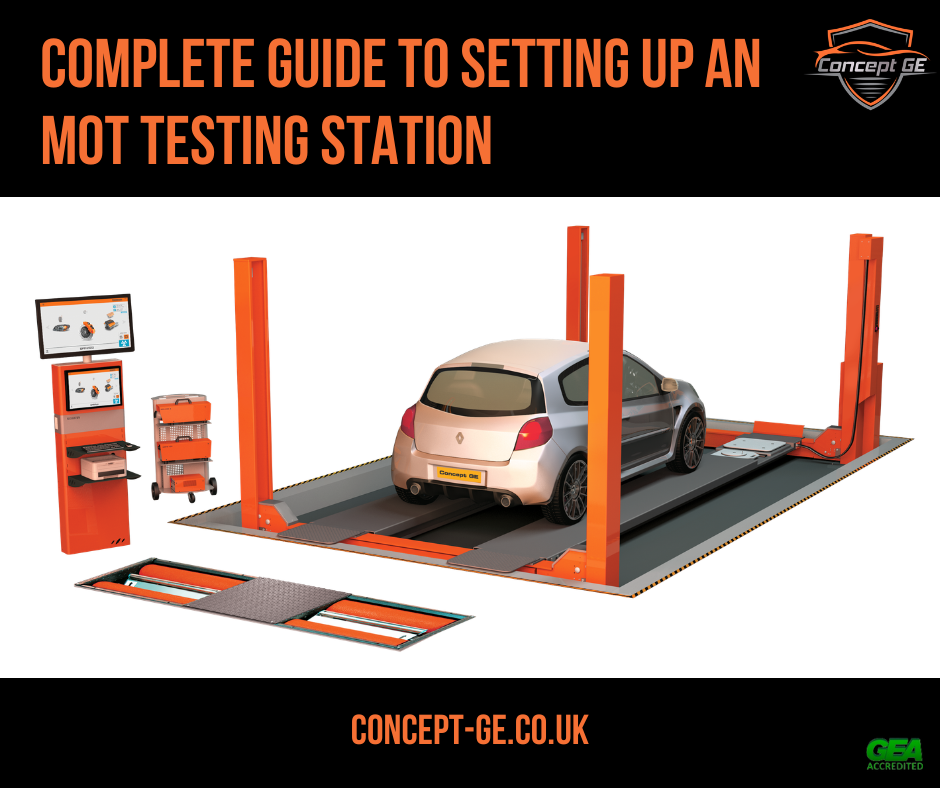
A typical MOT bay may include:
DVSA now requires many MOT stations to use connected MOT equipment. Connected equipment automatically communicates test results directly with the DVSA MOT Testing Service (MTS), helping improve accuracy and compliance.
Workshop layout has a major impact on workflow efficiency, technician productivity and DVSA compliance. The aim is to maximise usable workshop space while remaining fully compliant with DVSA testing requirements.
Before submitting your VT01 application, you will need CAD workshop drawings, site plans and equipment positioning layouts. These drawings show measurements of both the available space and the MOT equipment that will be fixed in place.
DVSA VT01 form must be completed to apply to set up or change an MOT test station, including becoming an Authorised Examiner (the person or business that runs it).
You will need:
Before you start to fill in your VT01 form you will need to set up an account on the DVSA MOT Testing Service system (MTS).
Once it’s submitted the DVSA will look at the application and if everything is correct then it will be passed to your local Vehicle Examiner (AE). They will then issue you with an Agreement in Principle (AIP). This authorises you to commence with your project and the installation of the MOT equipment.
For detailed information on completing the VT01 form, read our blog post: https://concept-ge.co.uk/vt01-form-setting-up-an-mot-test-station/
Depending on the premises, additional contractor work may be required. This can include electrical work, pit construction and lighting upgrades.
Every MOT station must appoint an Authorised Examiner Designated Manager (AEDM). The AEDM is responsible for MOT compliance, quality control and DVSA standards. The nominated individual must complete the appropriate training course. You will also need qualified MOT testers before commencing testing operations.
Once DVSA issues Agreement in Principle (AIP), installation can begin.
Concept Garage Equipment can supply everything you need from MOT tools through to the lift, inspection pit, gas analyser, headlight tester and anything else that is required for the class of vehicles you plan to be MOT testing. We can supply electricians, and builders and/or liaise with any other services or providers of your choice to ensure the installation gets done without a hitch. You can be involved as much or as little as you would like, you will, of course, be consulted throughout the process to ensure you are happy with every aspect of the MOT bay that is being constructed, and to check for any requested changes you require as it is being done.
Once installed and calibrated, we can also arrange for staff MOT training, so that all existing or new staff who will be doing MOT testing are suitably qualified and trained and familiar with your new MOT Bay equipment.
After installation is complete, the next stage is submitting the VT01-D form. This requests the final DVSA inspection visit. During the inspection, the Vehicle Examiner (VE) checks:
If everything meets requirements, the MOT station receives approval to commence testing.
Once approved, your MOT bay is authorised to begin testing vehicles. Now that you can perform MOT tests, you can generate additional workshop revenue and expand servicing and repair work. For many garages, this is the point where the investment quickly starts paying back.
If you are planning a new MOT bay, upgrading an existing MOT station, or converting a workshop into a fully compliant MOT testing facility, Concept Garage Equipment is here to help.
We offer nationwide support for MOT bay design, installation, equipment supply and DVSA compliance.
Call our friendly team today on 01302 203 888 or use the online contact form, and we will help you select, repair, upgrade or install the perfect garage equipment for your business.