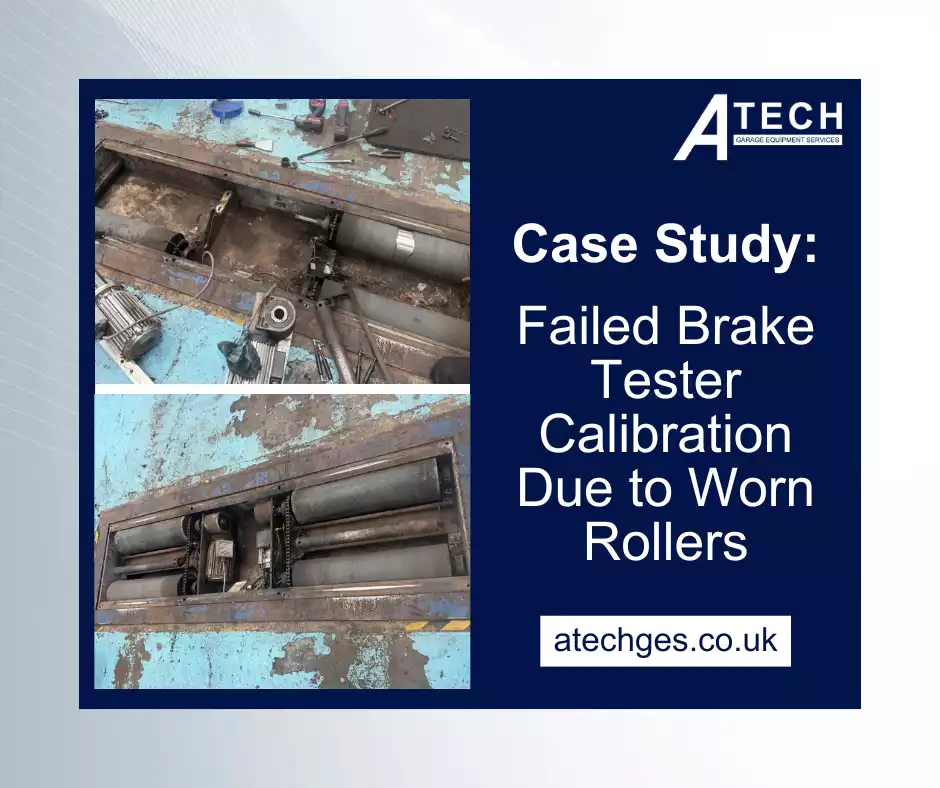
During a routine six-month brake tester calibration at a long-established MOT station, our engineer identified an issue that prevented the equipment from passing calibration. Although the roller brake tester was still producing accurate brake force readings when checked against our calibrated test equipment, the condition of the rollers themselves did not meet DVSA requirements. The grit coating on two of the rollers had worn away significantly, leaving large areas of exposed steel. Under DVSA and GEA guidance, roller surfaces must maintain adequate grip and cannot have significant sections where the grit has worn away. As a result, we were unable to issue a calibration certificate.
During this inspection we identified several additional issues:
Two heavily worn grit rollers requiring replacement.
Drive chains that had stretched beyond their adjustment limits.
Worn gas springs on the safety roller mechanism.
A significant build-up of dirt, mud and debris within the brake tester frame.
Work carried out included:
Removal of the worn rollers.
Removal and replacement of both drive chains.
Replacement of both safety roller gas springs.
Removal of motors and gearboxes to allow complete access for cleaning.
Full clean-out of accumulated mud, debris and contamination from within the brake tester.
Installation of replacement rollers with good grit condition.
Reassembly and adjustment of all components.
With the roller condition restored and all supporting components replaced, the brake tester successfully met calibration requirements and a calibration certificate was issued. The customer avoided the cost of replacing the entire brake tester by repairing and refurbishing the existing unit.