

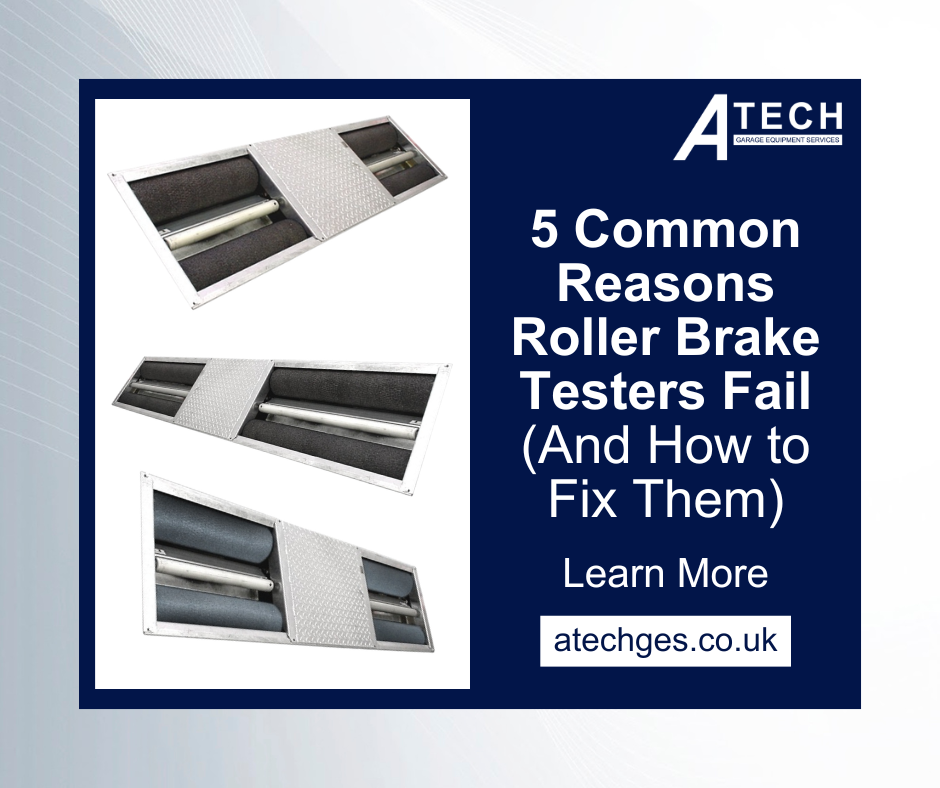
If you run an MOT bay, you already know how critical your roller brake tester is. When it fails, it doesn’t just disrupt your workflow, it can halt your entire garage operation.
The good news is, not every issue means a full replacement. Many of the most common faults can be identified early and resolved quickly with the right approach to roller brake tester repair and maintenance.
This guide breaks down the five most common causes of roller brake tester failure, how to fix them, and when it’s time to consider a more permanent solution.
One of the most common issues is reduced grip on the rollers. Over time, the surface becomes smooth and polished from constant tyre contact, leading to slippage during testing.
This results in:
In many cases, you won’t need a replacement, you need brake tester regritting. Regritting restores the textured surface of the rollers, improving traction and ensuring accurate test results.
Modern roller brake testers rely on sensors to measure braking force accurately. Over time, these sensors can become faulty.
Signs include:
Regular roller brake tester calibration is essential for maintaining accuracy.
Electrical issues are a major cause of garage equipment breakdown. Wiring faults, control panel failures, or software glitches can all affect roller brake tester performance.
Common symptoms include:
Electrical faults require expert diagnosis. Attempting DIY fixes can make the problem worse.
Roller brake testers operate in harsh environments, meaning dirt, water, brake dust, and debris all accumulate over time.
This can lead to:
Consistent roller brake tester maintenance is essential to keep your equipment running smoothly.
Like any mechanical system, roller brake testers experience wear and tear over time. Bearings, motors and drive components can degrade, especially in high-volume workshops.
Warning signs:
In some cases, individual components can be repaired or replaced. However, if multiple parts are failing, it may be more cost-effective to upgrade your system.
The best way to avoid costly repairs is prevention. Regular roller brake tester calibration ensures your equipment stays compliant and operational.
When your equipment fails, you need a partner who understands both the urgency and the technical complexity.
ATECH provides expert diagnostics, fast repairs and nationwide support. Whether it’s brake tester calibration, sensor calibration, or full system repair, ATECH helps keep your MOT bay running smoothly.